


How to Find Your Car’s Paint Code and Where to Look
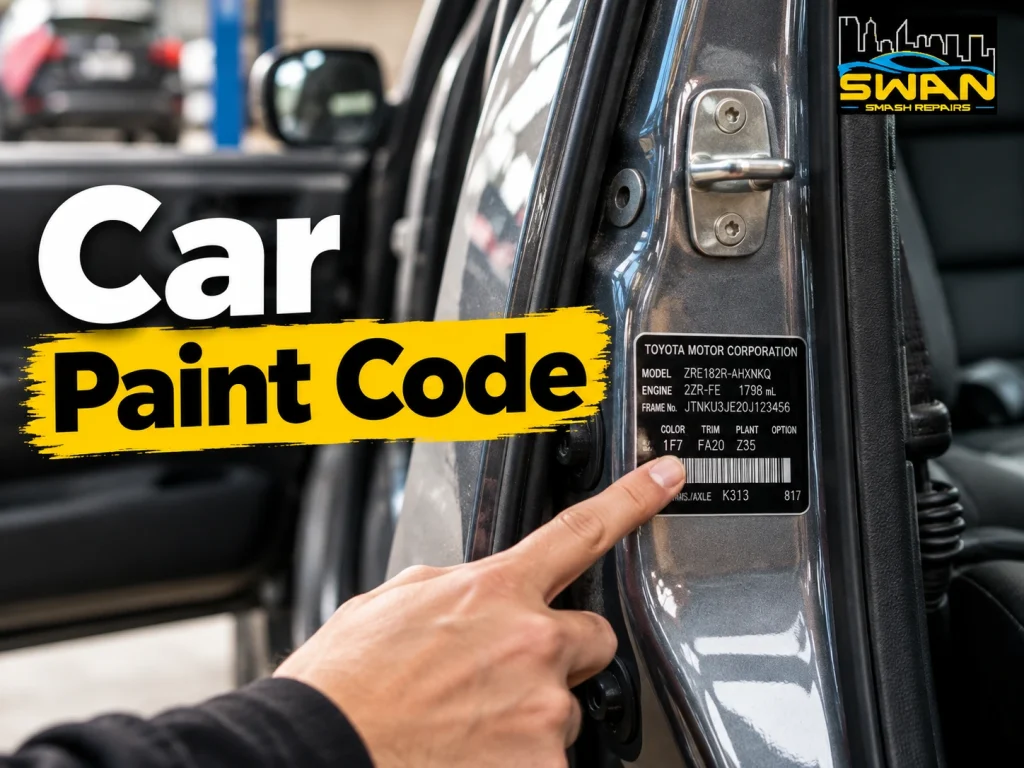
A car paint code is a short string of letters and numbers that tells a painter exactly which factory colour your vehicle wears. It’s the code, not the marketing name.
It matters the second you order touch-up paint or book a panel repair. Guess wrong, and the new paint sits next to the old like a mismatched sock.
The location changes by make and model. We match paint every week at our Welshpool workshop, so here is where we look, and in what order.
How to Find Your Car’s Paint Code
Your paint code sits on a sticker or metal plate somewhere on the car body. Check these five spots in order, and you’ll usually find it within minutes.
- Driver’s door jamb. Open the driver’s door and check the door edge and the B pillar. The paint code on the car door jambs is the most common spot, so most searches end here. Look for a white, silver or black label.
- Under the bonnet. Scan the firewall, strut towers and radiator support panel. Mazda and Mitsubishi often hide the code here.
- Inside the boot. Lift the boot floor and check the spare wheel area, then the inside of the boot lid. Audi and Volkswagen favour this spot.
- Glovebox and paperwork. Flick through the owner’s manual and service book. Many Holdens carry a service parts sticker in the glovebox or boot.
- The sticker itself. Wipe the label clean and photograph the whole thing, not just the code. Sun-faded stickers can look blank until you angle a torch across them.
Take the photo before you order anything. In our experience, a code read by torchlight and typed from memory is where most wrong colour orders start.
Common Locations for a Car Paint Code Sticker
A car paint code sticker most often lives on the driver’s door jamb, then the engine bay, then the boot. Here’s what each one looks like.
Door jamb and B pillar. Expect a compliance or tyre placard about the size of a phone. Toyota, Kia, Honda, Nissan and Hyundai usually use it.
Engine bay. This is usually a riveted metal plate rather than a sticker. It often sits at the rear of the engine bay or on a strut tower, so wipe off any grime before you give up.
Boot, spare wheel area and boot lid. Look for white paper stickers with barcodes, often tucked under the boot carpet.
Glovebox and less common spots. Older cars especially may list a “colour code” line on the first page of the dealer service book.
How to Identify the Paint Code on the Sticker
Look for a line labelled COLOR, PAINT, EXT PNT or C/TR, then read the short code beside it. That answers “what does a car paint code look like?” It’s usually two to five characters, such as K23, 46G or NH731P.
Common paint code labels to look for
- COLOR or COLOUR: Mazda, Mitsubishi, Nissan
- PAINT: Kia, Hyundai
- EXT PNT: Ford
- C/TR: Toyota, where the paint comes first and the trim second
A classic car paint code example is Toyota’s C/TR 1F7/FA20. The paint is 1F7, and FA20 is the interior trim.
Paint code vs. VIN, trim code and other vehicle numbers
| Number | Looks like | What it tells you | Use for ordering paint? |
| Paint code | 2 to 5 characters | Factory exterior colour | Yes |
| Trim code | Often after a slash | Interior colour and material | No |
| VIN | 17 characters | Your exact vehicle | Only to look up the colour |
| Model or engine code | Varies | Build details | No |
Car Paint Code Locations by Brand
Car paint codes in Australia follow each manufacturer’s own system, so the location depends on the badge. The examples show the format only, so always read your own label and copy every character.
Japanese brands
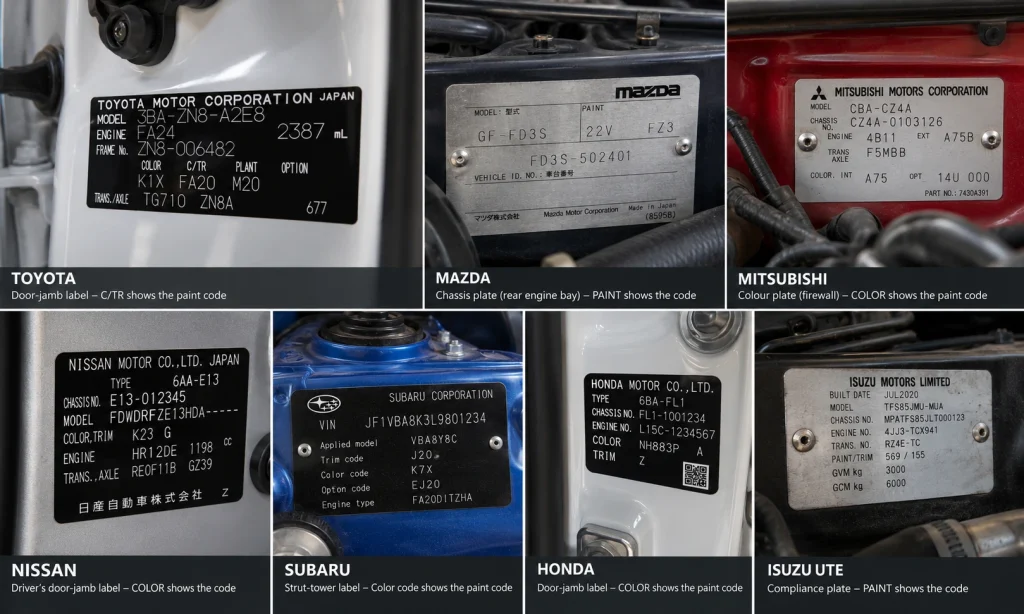
Toyota. Check the driver’s door jamb first, then the passenger side. Find the C/TR line: the first code is the paint and the second is the trim. Example: C/TR 1F7/FA20 means paint 1F7.
Mazda. Open the bonnet and find the chassis plate at the rear of the engine bay. It also carries the VIN, so a 17-character number tells you you’re in the right place. Example: COLOR 46G.
Mitsubishi. Head to the firewall in the engine bay. The plate lists colour and trim separately, so read the COLOR line only. Example: COLOR W37.
Nissan. Try the driver’s door jamb first. The plate lists the colour beside other codes, so don’t grab the wrong line. Example: COLOR K23.
Subaru. Start at the driver’s door jamb. If it isn’t there, check the radiator support or the strut tower. Example: K1X.
Honda. The code is normally on the driver’s door jamb label. Copy the full code, including the letters at the front. Example: NH731P.
Isuzu Ute. Check the compliance plate on the door pillar, then the engine bay. Layouts vary by model and year, so confirm your code with the manufacturer or a dealer before ordering paint.
Korean brands
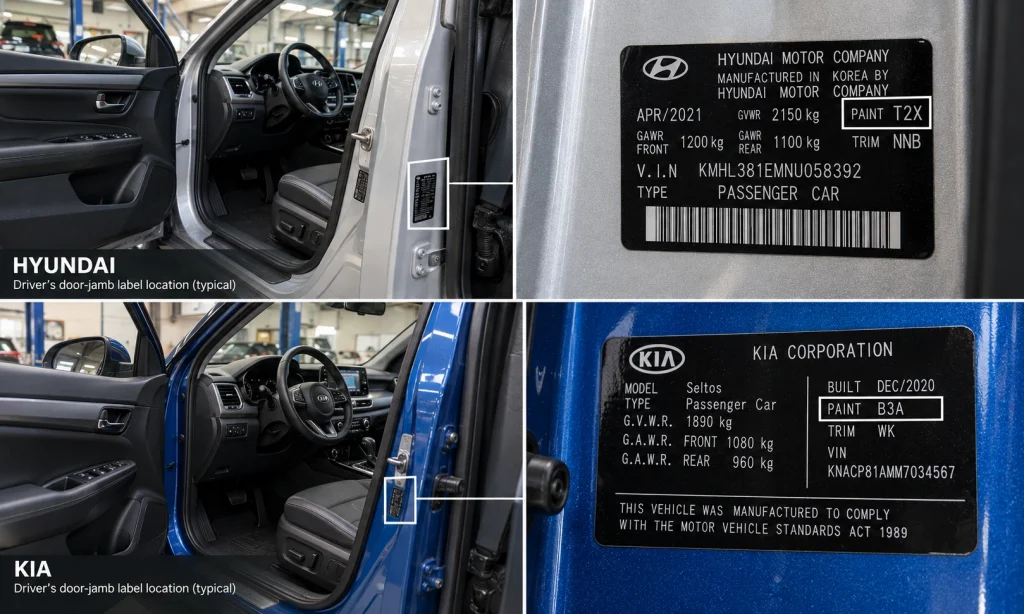
Hyundai. Start at the driver’s door jamb label. Some models hide the code in the engine bay instead, so check there if the jamb is empty. Example: PAINT S4N.
Kia. Kia keeps it simple. The code is on the driver’s door jamb label, on the line marked PAINT. Example: PAINT SWP.
European, American and Chinese brands
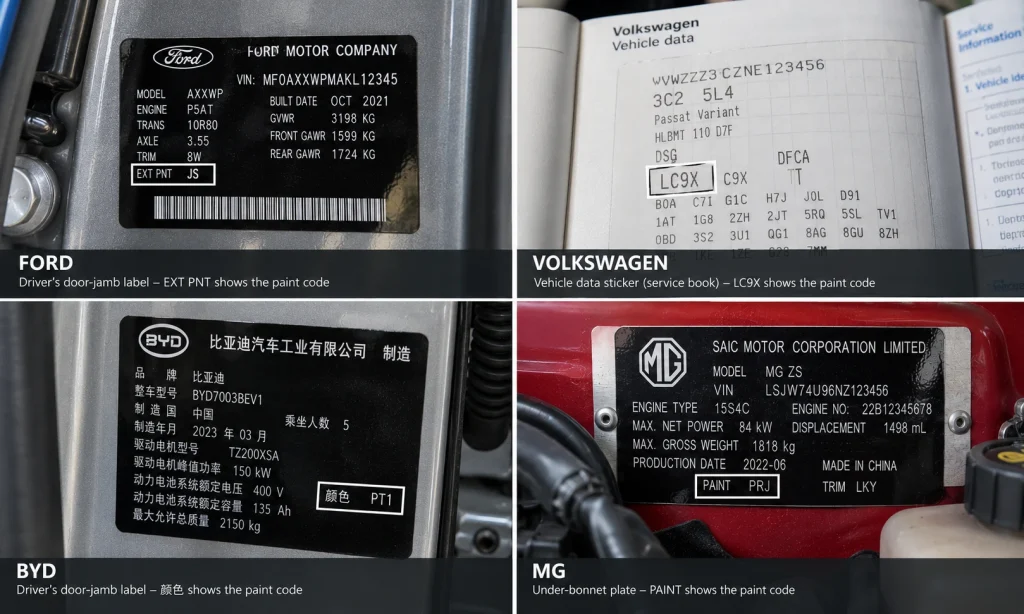
Ford. Read the EXT PNT line on the compliance label on the driver’s door jamb. Ignore the tyre and weight details around it. Example: EXT PNT 5A.
Volkswagen. Check the vehicle data sticker inside the service book cover, or the sticker in the spare wheel area. Give the painter all four characters. Example: LC9A.
BYD. Find the black info label on the driver’s door jamb. Look for 颜色, the Chinese word for colour, and read the code beside it. Photograph the label if you can’t decode it.
- Check the door jamb or under the bonnet for a plate or sticker. Codes are typically three or four letters or numbers.
When Your Car’s Paint Code Is Missing or Hard to Read
If you can’t find the paint code on the car, use your VIN, your paperwork or a professional colour match. Here’s the order we suggest.
Use your VIN to look up the factory colour
The VIN doesn’t spell out the colour, but a dealer’s parts department can pull the factory colour from build data. That’s the most reliable route for a car paint code by VIN.
You’ll find the VIN on the compliance plate, the windscreen corner and your registration papers.
A car paint code finder online may let you search by make, model and year. Some accept car paint code by rego searches too, but treat those results as a starting point and confirm them with your VIN.
Check your records or get the paint matched professionally
Look through the logbook, original sales invoice and past repair invoices. Insurance repair paperwork sometimes lists the code as well.
Still nothing? This is how to match car paint without a code. A painter compares the paint on your car against known formula variants. Even better, bring the fuel filler flap. It’s small, easy to remove and usually less weathered than the panels.
Why the Paint Code Is Only the Starting Point for a Colour Match
The code gives you the factory formula, but your paint has aged since the day it left the factory. That gap is why a perfect visual match takes skill, not just a tin of paint.
- Sun exposure: Perth’s harsh UV slowly fades reds, blacks and clear coat.
- Paint variations: The same code can shift slightly between batches and build plants.
- Metallic and pearl finishes: The colour changes with the angle of the light.
- Previous resprays: The paint may no longer match the code at all. If yours has been resprayed, a car respray specialist can tell you what’s really on the panels.
That’s why a good painter tints the mix to your car’s current colour and blends it into the neighbouring panels.
Get Professional Car Spray Painting in Perth
Swan Smash Repairs is a family-owned Welshpool workshop with more than 30 years of experience. We’re an MTA-certified body repairer and exclusively use PPG refinishers. Our car spray painting team matches your colour to the car as it looks today, and every repair comes with a lifetime warranty (conditions apply).
Need a Perfect Colour Match? Talk to Swan Smash Repairs
Got the code, or stuck without one? Either way, we’ll help. Send us your car’s details, and we’ll work out the right colour, then give you a clear quote with no guesswork.
FAQs
Are car paint codes the same across different brands?
No. The same code can mean different colours on different makes, so always quote your make, model and year with the code.
Can I use my car’s colour name instead of the paint code?
Not reliably. Names repeat across years and variants, and a “silver” from one year can differ from the next. Use the code.
How do I find the paint code on an imported car?
Check the compliance plate first. Imported Japanese models often use a different plate layout, so a painter or VIN lookup may be needed.
Is touch-up paint enough for a big scratch?
Only for small chips and light scratches. Larger damage needs sanding, priming and spraying, or the repair will look patchy.
Do I need to update my details if I respray my car a different colour?
Yes. Tell your insurer and update the colour on your registration so your records match the car.