


What Is PDR? How Paintless Dent Repair Works on Car Dents
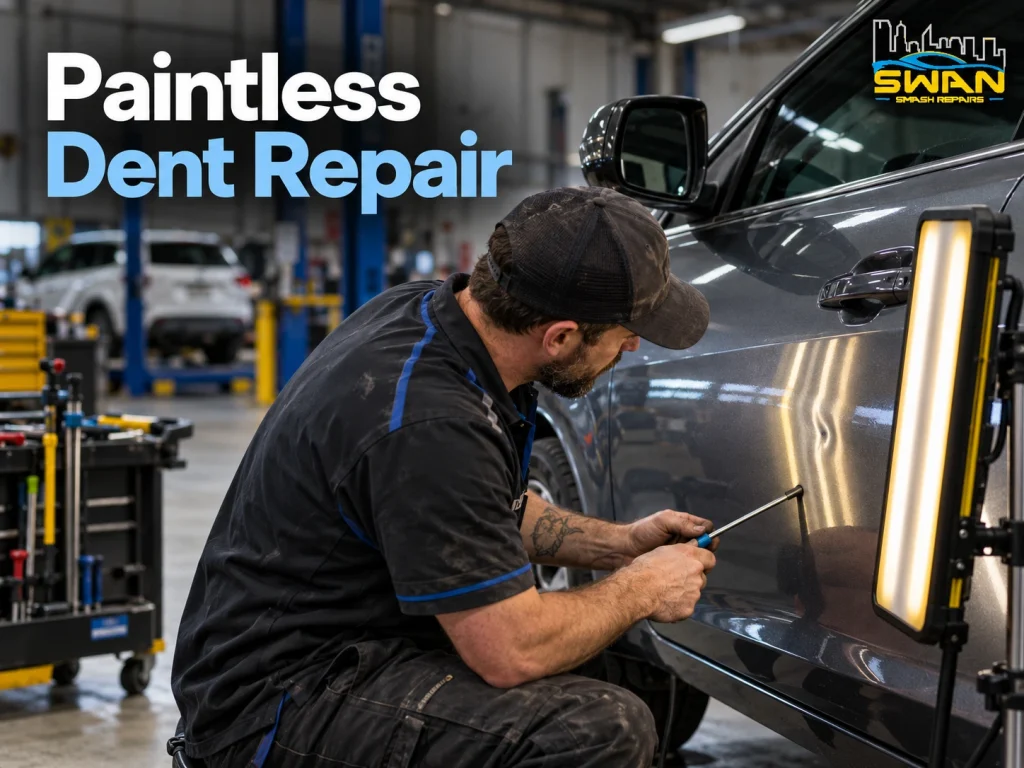
A small dent can be surprisingly annoying. You might notice it every time you walk past the car, even though the damage itself seems minor. The good news is that Paintless Dent Repair (PDR) can sometimes remove a dent without sanding, filling or repainting the panel.
The process involves carefully assessing the damage, finding safe access to the back of the panel and using specialised tools to gradually reshape the affected area. The technician checks the panel as the repair progresses to help restore its original contours as closely as possible.
PDR is generally most suitable when the existing paint is intact, and the panel has not been severely stretched, sharply creased or otherwise distorted.
What Is PDR (Paintless Dent Repair)?
Paintless Dent Repair is a method of repairing suitable dents while keeping the original paint finish on the panel.
Instead of filling the dent, sanding it smooth and repainting the area, the damaged panel is carefully reshaped from behind. The technician uses specialist tools to work the metal back into a more natural contour.
That’s what makes PDR different from a more traditional body repair. Depending on the damage, conventional repairs can involve filler, sanding, preparation and repainting.
PDR isn’t suitable for every dent, either. Before deciding how to repair it, the damage needs to be looked at properly. Things such as the depth of the dent, its shape, where it sits on the panel, the condition of the paint and whether the back of the panel can be reached all matter.
If you’ve got a small dent or parking ding, a professional car dent removal service can assess the damage and help determine the most suitable way to repair it.
How Does Paintless Dent Repair Work on Car Dents?
One of the biggest misconceptions about PDR is that it’s simply a case of pushing the dent out.
In reality, the process is much more controlled than that. The technician works gradually, checking the panel as they go and making small adjustments until the damaged area begins to return to its original shape.
1. The dent is checked first
Before anything is pushed or pulled, the dent needs a proper inspection.
The technician will look at how deep it is, what shape it has taken and where it sits on the panel. They’ll also check the paint and the surrounding area for signs that the metal has been stretched or affected by the impact.
Access is a big part of the decision too. A shallow dent in the middle of a panel can be relatively straightforward to reach, while a similar dent near an edge, body line or internal reinforcement may be much trickier.
That’s why two dents that look roughly the same size can have completely different repair options.
2. Access is found behind the damaged area
PDR usually means working on the back of the panel.
Exactly how this is done depends on where the dent is. Sometimes the technician can reach the area directly. Other times, trim or internal components can get in the way and make access more difficult.
Car doors are a good example. There is more going on inside a door than you might expect, and reinforcement sections can limit where a tool can be placed.
The technician’s job is to get the access they need without creating further problems for the vehicle.
3. Lighting helps show what the panel is doing
A dent can look quite different depending on the light hitting it.
That’s why specialised lighting is used during PDR. Reflections across the panel can make small changes in the surface easier to see, including the low point of the dent and any changes around it as the repair progresses.
This is particularly important towards the end of a repair. What looks almost perfect from one angle can still show up in a reflection from another, so visibility helps the technician keep an eye on the panel’s overall shape.
4. The metal is worked back into shape
Once the technician has suitable access, specialist PDR tools such as rods and picks can be used behind the panel.
The pressure is applied carefully to selected areas rather than all at once. The idea is to move the metal gradually instead of trying to force the dent out in one go.
This is where experience really matters. Too much pressure, or pressure in the wrong spot, can create a high point or affect the surrounding contour. Small, controlled movements give the technician much more control over the final result.
5. The panel is checked as the repair progresses
PDR isn’t something that’s finished after one push.
The panel is checked repeatedly throughout the repair, with the technician looking at the surface and reflections to see how the shape is changing.
The goal is not simply to make the dent less noticeable. Ideally, the repaired area should flow naturally into the rest of the panel without obvious distortion.
Not every dent can be returned to a perfect condition, either. In some more difficult cases, PDR may significantly improve the appearance without completely restoring the original panel shape. A proper assessment helps set realistic expectations from the start.
What Dents Can Be Repaired With PDR?
PDR can be an option for small to moderate dents, door dings, minor parking damage and some hail dents, particularly when the paint is still intact.
You may be looking at a possible PDR repair if the damage is something like:
- A small parking dent
- A door ding
- Minor impact damage
- A shallow crease
- Some types of hail damage
- A small dent in a suitable body panel
The important thing is not to judge a dent by size alone.
A fairly large, shallow dent can sometimes be easier to repair than a much smaller dent with a deep crease or sharp point; where the damage is located matters as well. Dents close to panel edges, body lines or internal reinforcement c an present more challenges.
So if you’re searching for small dent repair, don’t assume that a quick look at the diameter of the dent will tell you whether PDR is the right solution. The paint, panel shape, depth and access all need to be taken into account.
When Is PDR Not Suitable?
PDR has clear advantages, but it isn’t the answer for every type of damage.
It may not be suitable if the paint has cracked or broken, the panel has been badly stretched, the dent contains a severe crease or there isn’t safe access to the back of the damaged area.
Here are some of the main things a technician will look for.
Damaged paint: PDR reshapes the panel, but it doesn’t replace paint that has been chipped, cracked or removed.
Severe creasing: A sharp or deep crease can mean the panel has been significantly deformed and may need a different repair method.
Panel edges: A dent close to the edge of a panel can be harder to work because there is less room for controlled movement.
Previous bodywork: If the panel has already been repaired, its condition may be different from an untouched panel, and that can affect how it responds during PDR.
Limited access: Sometimes the biggest issue isn’t the dent itself. If the rear of the damaged area can’t be reached safely, another repair option may make more sense.
This is why a small dent isn’t automatically a PDR job. After looking at the actual damage, a repairer can determine whether the panel is suitable for PDR or whetherprofessional panel beating would be the better approach.
Can PDR Fix a Car Door Dent?
Yes, some car door dents can be repaired using PDR, provided the paint is intact, the panel hasn’t been severely distorted, and there is safe access to the damaged section.
Door dings are particularly common in busy car parks and tight spaces. The impact might look minor from the outside, but the inside of the door can make the repair more complicated.
Doors contain reinforcement sections and other components that can affect where tools can go. The position of the dent matters too. A shallow dent in a flat part of the door may be easier to work with than damage sitting directly on a body line.
So if you’re trying to fix a car door dent, the size you can see isn’t the only thing that matters. The technician also needs to consider the shape of the damage, the paint and what’s happening behind the panel.
Can PDR Repair Dents and Scratches?
This is where it’s important to separate the dent from the paint damage.
PDR can reshape a suitable dent, but it does not repair scratched, chipped or broken paint.
For example, a panel may have a noticeable dent but still have an intact paint finish. That can make it a possible PDR candidate. If the same impact has cut through or damaged the paint, the panel and paintwork may need to be dealt with separately.
Where repainting is required, car spray painting may form part of the wider repair.
So before assuming PDR will solve everything, it’s worth checking the paint as well as the dent itself.
PDR vs Traditional Dent Repair: What’s the Difference?
Both PDR and traditional dent repair are designed to restore damaged bodywork, but the way they get there is different.
| Paintless Dent Repair | Traditional Dent Repair |
| Works by reshaping suitable dents | Can involve more extensive panel repair |
| Keeps the original paint when the paint is suitable | May involve repainting the repaired area |
| Uses specialist tools and controlled pressure | Can involve filler, sanding, preparation and paint |
| Best suited to certain types of dents | Can be used when damage is unsuitable for PDR |
| No colour matching is needed when the original paint is retained | Colour matching may be required after repainting |
PDR can make sense when the panel is suitable and the existing paint is in good condition. Traditional repair may be needed where there is damaged paint, major deformation or another factor that prevents PDR from being used effectively.
Sometimes the repair method is obvious. Sometimes it isn’t. The condition of the actual panel is what should guide the decision.
How Do You Know If a Small Dent Is Suitable for PDR?
It’s tempting to look at a dent and think, “It’s small, so PDR should be fine.”
Unfortunately, it isn’t quite that simple.
Before choosing a repair method, it’s worth considering:
- Is the original paint still intact?
- Is the dent shallow or sharply creased?
- Is it close to a panel edge or body line?
- Has the panel been repaired before?
- Does the surrounding metal still look normal?
- Can the back of the damaged area be reached safely?
A professional inspection is a much better way to answer these questions than trying to work it out from a photo.
A photograph can certainly help give a repairer an idea of what they’re dealing with, but seeing the actual panel makes it easier to judge the damage and decide which repair method is appropriate.
Have a Small Dent? Talk to Swan Smash Repairs
A small dent doesn’t always need a full traditional repair, but it does need the right assessment.
Swan Smash Repairs provides Car Dent Removal, Panel Beating and Car Spray Painting from its Welshpool workshop, so the repair approach can be considered according to the condition of the damage.
If you’ve noticed a parking dent, door ding or other panel damage on your vehicle, you can contact Swan Smash Repairs to discuss the damage.
You can also request a free quote and include vehicle details and images through the online form.
FAQs
How big of a dent can paintless dent repair fix?
There isn’t a universal maximum size for PDR. A larger, shallow dent can sometimes be suitable, while a smaller dent with a deep crease or significant distortion may not be. The size is only one part of the assessment, along with the shape, location, paint condition and access behind the panel.
What dents can be repaired with PDR?
PDR is generally considered for dents where the original paint is intact and the panel hasn’t been severely stretched or distorted. Small parking dents, door dings, some hail dents and certain shallow creases may be suitable. The damage still needs to be inspected before a repair method can be confirmed.
How much will it cost to get a small dent out of a car?
There isn’t one set price for every small dent. The cost can change depending on where the dent is, how deep it is, the size of the affected area and how complicated the repair will be. An assessment and quote based on the actual vehicle is a more useful guide than a general price estimate.
Is Paintless Dent Repair permanent?
When a suitable dent is properly repaired, PDR reshapes the damaged panel rather than simply covering the visible dent. The final result depends on the condition of the panel and the nature of the damage, which is why an assessment is important before repair work begins.
Where can I repair a small dent in Perth?
Small dents can be assessed by vehicle repair businesses across Perth. Swan Smash Repairs provides car dent removal from its Welshpool workshop at Unit 4–6, 110 Harris Street, Welshpool, WA 6106, serving customers in Welshpool and surrounding Perth suburbs.