


How Long Does Smash Repair Take? A Guide to Repair Times in 2026
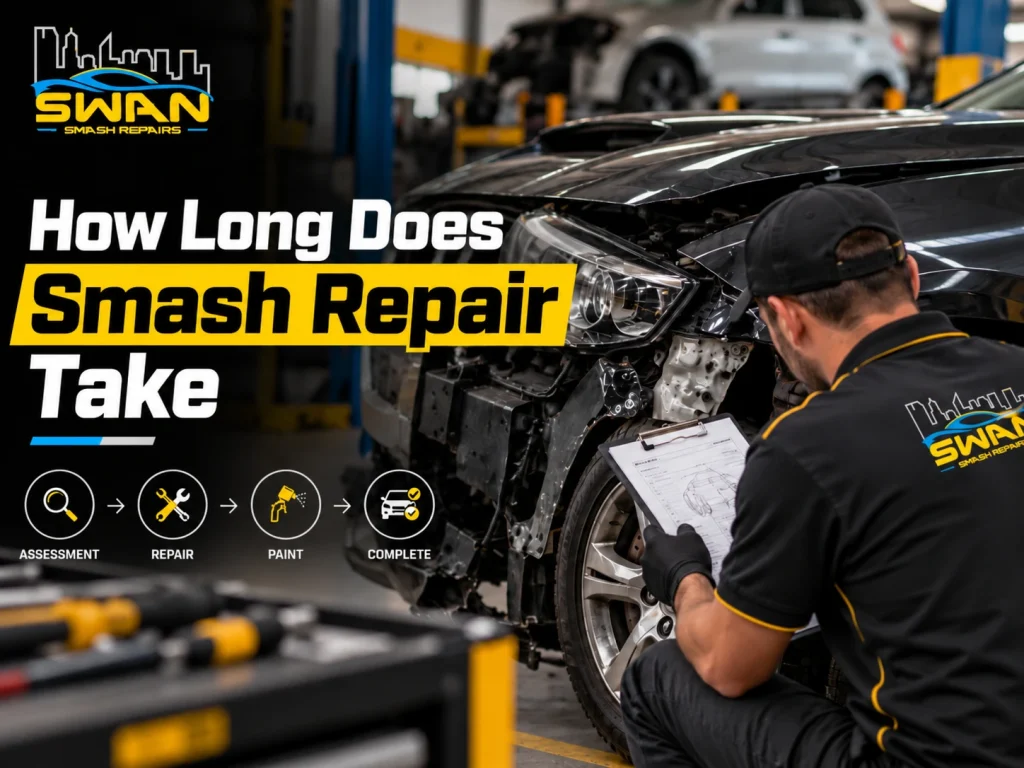
“How long does smash repair take?” is usually the first thing people ask after an accident, and it’s a fair question. You might need your car for work, the school run or getting to appointments, so every day without it counts.
The honest answer is that it depends. A small dent can be sorted in a few days, while damage across several panels can keep a car in the workshop for weeks. The damage itself, the parts, the paintwork and any insurance approval all play a part. Once you understand how those pieces fit together, it’s much easier to plan and to ask your repairer the right questions.
Disclaimer: The timeframes below are general planning estimates. They aren’t guaranteed completion dates, and they aren’t confirmed turnaround times for any particular repairer. A reliable estimate needs an inspection of your vehicle first, and extra damage, parts delays or approval requirements can change the date.
How Long Does a Smash Repair Take for Different Types of Damage?
The table gives broad examples to help you plan. Think of the figures as working days once your car is booked in, the repair is approved, and the parts are on hand. Time spent waiting before that point isn’t included, and real jobs can fall outside these ranges.
| Type of damage | General estimate | What can change it |
| Minor scratches, scuffs or a small dent | Around 1–3 working days | Depth of the damage, paintwork needed, repair method |
| Damage to one or two panels | Around 3–10 working days | Panel straightening, replacement parts, colour matching, painting |
| Damage across several panels | Often a couple of weeks or more | Number of parts involved, repair work, paint preparation |
| Major structural or collision damage | Several weeks or longer | Extent of damage, parts supply, extra repair work, final checks |
These are guides, not industry standards. Two dents that look the same from the outside can need very different amounts of work. A shallow dent in flat metal might need little attention. A creased one, or one that has cracked the paint, takes longer.
Bumpers are a good example. A scuffed bumper may just need preparation and repainting. A bumper that has split, or damaged its mounting points or nearby parts, is a bigger job. What you can see doesn’t always tell the full story.
If you’d like to know what the work involves, have a look at the different types of car smash repairs and bumper repairs.
What Affects Smash Repair Time?
Some factors come from the damage, others from parts, approvals and the work needed to get your car back to a safe, finished standard.
The extent of the damage
Dent size isn’t a reliable guide to repair time. A deep crease may need the metal reshaped, repaired or replaced, which takes longer than a wide, shallow dent.
Damage also doesn’t always stop at the surface. A knock can affect brackets, supports or other parts hidden behind a bumper or body panel. That’s why a proper inspection matters. If a panel needs straightening or replacing, panel beating becomes part of the job. For heavier collision damage, vehicle structure is checked using measuring equipment, which adds time but is there for good reason.
Replacement parts
Parts are one of the most common reasons a repair runs longer than people expect. A job might need a new bumper cover, headlight, bracket or body panel. How long those take to arrive depends on the vehicle, the part and the supplier. Some are available quickly, others have to be sourced from elsewhere.
The repairer also has to confirm they’ve got the right part before ordering it. If one turns up damaged or doesn’t fit, a second order adds more time. Before the work starts, ask whether the parts you need are available and when they’re expected.
Insurance assessment and approval
If you’re claiming through insurance, there can be extra steps before the workshop gets going. The insurer may need to assess the damage, review the quote and approve the work. If more damage shows up once parts are removed, the repairer may need to document it and get further approval, depending on your claim.
A holdup here doesn’t mean the repair itself is difficult. The car may simply be waiting on a decision. If you’re claiming, ask what’s been completed and what’s still outstanding. It helps you separate claim waiting time from actual repair time.
Panel preparation, painting and curing
Fixing the shape of a panel is only part of the job. Where paintwork is needed, the surface has to be prepared first. Depending on the repair, that can mean removing damaged paint, priming, matching the colour and applying coatings. The finish then needs time to dry or cure before the next stage.
Rushing this affects the result, so a good schedule allows for it. A small localised repair is quite different from a larger respray. You can see more about this stage on our car spray painting page.
Hidden damage and changes to the repair plan
Sometimes the first estimate has to change once the car is taken apart. A dented outer panel can hide a bent bracket or another affected part. When that happens, the job may need extra parts and extra work, which can move both the cost and the completion date.
If your repairer tells you the plan has changed, ask them to explain what was found and how it affects the finish date. Where insurance is involved, the extra work may need to be discussed with the insurer too.
Final assembly and checks
A job isn’t finished when the dent is out and the paint is dry. Removed parts need to be refitted, and the completed work gets checked, including panel fit, lights and fittings. Depending on the vehicle and the damage, some repairs need extra checks of relevant vehicle systems before the car goes back on the road. That time is part of doing the job properly, not wasted time at the end.
How Long Does It Take to Repair a Car After an Accident?
The clock starts before your car reaches the workshop. From accident to collection, the process usually looks something like this:
- Accident and claim. If you’re claiming, you contact your insurer and gather the details.
- Inspection and quote. The repairer assesses the damage and works out what needs doing.
- Approval and parts. The repair is approved where required, and replacement parts are sourced.
- Repair and refinishing. Panel work, replacement components and paintwork are completed as needed.
- Reassembly and checks. The car is put back together, checked and made ready for collection.
These steps don’t always run in a neat line. Some work can start while other arrangements are still being made, but certain tasks have to wait for earlier ones to finish. The order and timing also vary from job to job and claim to claim.
Why Do Smash Repairs Take So Long?
When a car has been in the workshop longer than you hoped, it’s easy to assume the repair itself is slow. Often it isn’t. Your car isn’t being worked on for every day it’s away.
Total time off the road is not the same as hands-on repair time. Your car might wait for an assessment, a quote approval, a part to arrive or a free spot in the workshop schedule before the real work begins. So a job that needs a week of workshop time won’t necessarily be ready a week after the accident.
Waiting time usually comes from a handful of places: back-ordered parts, a repair plan that has changed, an approval that hasn’t come through yet, or a busy period in the workshop. That’s why it helps to ask for two separate things: how long the repair work will take, and the date your car is expected to be ready for collection.
What Can You Do to Keep Things Moving?
You can’t control every step, but a few things help.
- Be clear at the start. Explain how the accident happened and mention anything that worries you. Send photos if your repairer asks for them. An inspection will still be needed to see the full picture.
- Ask what’s outstanding. Check whether any parts or approvals are still needed, and whether your booking date depends on parts arriving.
- Reply quickly. If your repairer or insurer asks you to confirm something, a prompt answer stops the next stage from stalling.
- Agree on updates. Ask to be contacted if the plan changes or a new date is set, so you’re not chasing every day.
One thing not to do is ask for safety checks or necessary preparation to be skipped to save time. A repair done properly beats an unrealistic deadline.
What If Your Repair Is Taking Longer Than Expected?
It’s frustrating, especially if you rely on your car every day. Instead of only asking “when will it be ready?”, try asking what’s holding it up:
- Which stage is the repair at? This tells you whether it’s waiting on parts, approval, bodywork, paint or final checks.
- Is anything still outstanding? A part, a decision or some extra work could be the hold-up.
- Has the completion date changed? A revised date you can trust is more useful than one that’s no longer realistic.
- When will I hear from you next? Agree on a time so you’re not left guessing.
If extra damage has been found, ask for an explanation and how it affects the timeline. For an insurance job, check whether the insurer needs to approve the change.
Quotes, Estimates and Your Rights in WA
It pays to keep a clear record of what’s been agreed and any changes along the way. WA Consumer Protection’s guide to repairs to your motor vehicle is a good place to start. A few points from it are worth knowing:
- Ask for it in writing. Wherever possible, ask for a written quote or estimate that sets out the work and cost.
- Quotes and estimates differ. Accepting a quote forms a contract that binds you and the repairer. An estimate isn’t a fixed price, though the repairer must take care not to deliberately underestimate.
- Extra repairs. Consumer Protection recommends you don’t automatically authorise additional repairs. Ask the repairer to justify the work and give you a written report or quote with parts and labour.
- Licensing. WA law requires motor vehicle repair businesses to be licensed. You can check a licence on the Department’s website.
- Reasonable time. Under the Australian Consumer Law, services must be provided within a reasonable time. The date may shift as a repair progresses, but you should always understand the current plan and what’s affecting it.
If you can’t sort out a problem with your repairer, you can contact Consumer Protection through its complaints page.
Talk to Swan Smash Repairs About Your Vehicle
Being without your car throws your whole routine out, and a clear repair plan makes it easier to cope. How long it takes comes down to the damage, the parts involved and the work needed before your car is ready for the road.
If your vehicle has been damaged in an accident, get in touch with Swan Smash Repairs to talk through the next step. Ask what the repair might involve, what could affect the timing and when you can expect an update.
You can contact us here, call (08) 9361 8202 or visit us.
FAQs
Can I drive my car while waiting for repairs?
It depends on the damage and whether the car is safe and legal to drive. Cosmetic damage may not stop you from using it, but damage to lights, wheels, steering, visibility or other safety-related parts can make it unsafe. If you’re unsure, have a qualified repairer look at it first. If you think it might be unsafe, don’t drive it.
Do insurance repairs take longer?
They can, because there are often extra steps before the work begins, such as assessment, quote review and approval. That doesn’t mean the repair itself takes longer. It’s more that the car may wait for a decision before work starts, and extra damage found later may need further approval.
Does a repairer have to provide a courtesy car?
No. WA Consumer Protection says a repairer doesn’t have to provide a courtesy car while your vehicle is being fixed, though some do. Your insurance policy may cover a hire car or replacement transport under certain conditions, so check your cover.
Can I refuse extra repairs if new damage is found?
You can ask for an explanation and a revised quote before agreeing to anything. Consumer Protection says you don’t have to pay for repairs you didn’t ask for or authorise. Ask the repairer to document the damage, explain the work and confirm the extra cost. If an insurer is handling your claim, check their approval process before going ahead.